The Passage Into Paradise
Part I
We return to the transcept, or Great Crossing, and face the east end of
our Cathedral Soul and look into The Passage Into Paradise. Here is the
chancel, the area containing the choir and the sanctuary.
Separating the chancel from the nave
in a Gothic cathedral is often a rood,
a large crucifix, typically mounted upon
an elaborately ornamented rood screen.
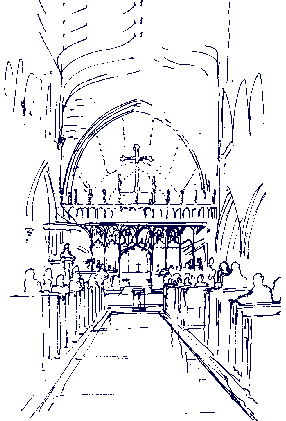
Sketch of East End of St Peter's Cathedral,
Nottingham, as seen from the nave, clearly
showing the elaborate rood screen, with
the large rood mounted on top of it, with
the altar seen through the rood screen. |
 |
The Rood
Under The Blood
(John Henry Newman, Parochial and Plain Sermons, London: Longmans, Green, 1891
1:208,209, 210, 211)
John Henry Newman
It is intended that we should look to ourselves and rather consider why
we have privileges given us than why others have not the same. Our
Saviour repels such curious questions more than once. "Lord, and what
shall this man do?" St. Peter asked about St. John. Christ replied, "If
I will that he tarry till I come, what is that to thee? Follow thou
Me.
[And, thus of the Scriptures Newman spoke] -- (it)
increases our difficulties. It is indeed a remarkable circumstance,
that the very revelation that brings us practical and useful knowledge
about our souls, in the very act of doing so, nay (as it would seem), in
consequence of doing so, brings us mysteries.
[He tells us that if there is an endless state of blessedness there is
also] a state of endless misery too. Now, how great
a mystery is this! yet the difficulty goes hand in hand with spiritual
blessing.
It is still more strikingly to the point to refer to the message of
mercy itself. We are saved by the death of Christ; but who is Christ?
Christ is the very Son of God, Begotten of God and One with God from
everlasting, God incarnate. This is our inexpressible comfort , an a
most sanctifying truth if we receive it rightly; but how stupendous a
mystery is the incarnation and sufferings of the Son of God! Here, not
merely do the good tidings and mystery go together, as in the revelation
of eternal life and eternal death, but the very doctrine which is the
mystery brings the comfort also.
Frail man requires pardon and sanctification; can he do otherwise than
gratefully devote himself to, and trust implicitly in, his Redeemer and
Sanctifier? But if our Redeemer were not God, and our Sanctifier were
not God, how great would have been our danger of preferring creatures to
the Creator! What a source of light, freedom, and comfort is it to know
we cannot love them too much or humble ourselves before them too
reverently, for both the Son and Spirit are separably
God. Such is the practical effect of doctrine; but what a mystery also
is herein involved. What a source of perplexity and darkness (I say) to
the reason is the doctrine which immediately results from it! For if
Christ be by Himself God, and the Spirit be by Himself God, and yet
there be but one God, here is plainly something altogether beyond our
comprehension.
It seems, then, that difficulties in revelation are especially given to
prove the reality of our faith. What shall separate the insincere from
the sincere follower of Christ? When the many own Christ with their
lips, what shall try and discipline His true servant and detect the
self-deceiver? Difficulties in revelation mainly contribute to this
end. They are stumbling-blocks to proud and unhumbled minds and were
intended to be such. Faith is unassuming, modest, thankful, obedient.
It receives with reverence and love whatever God gives, when convinced
it is His gift.
The Rood Screen
[the step beyond this dimension]
(John Henry Newman, Parochial and Plain Sermons, London: Longmans, Green, 1891
PPS 4:259-260)
Thus, though the Lord was with him [Joseph], apparently all things were
against him. Yet afterwards he saw what was so mysterious at the time
-- "God did send me before you", he said to his brethren, "to preserve
life . . . It was not you that sent me hither but God; and He hath
made me a father to Pharaoh and lord of all his house and a ruler
throughout all the land of Egypt.
If even devils, sagacious as they are, spirits by nature and experienced
in evil, cannot detect His hand while he works, how can we hope to see
it except by that way which the devils cannot take, by a loving faith?
How can we see it except afterwards as a reward to our faith, beholding
the cloud of glory in the distance, which when present was too rare and
impalpable for moral sense.
And so, again, in a number of other occurrences, not striking, not
grievous, not pleasant, but ordinary, we are able afterwards to discern
that He has been with us and, like Moses, to worship Him. Let a person
who trusts he is on the whole serving God acceptably look back upon his
past life, and he will find how critical were moments and acts which at
the time seemed the most indifferent: as, for instance, the school he
was sent to as a child, the occasion of his falling in with those
persons who have most benefited him, the accidents which determined his
calling or prospects whatever they were. God's hand is ever His own,
and He leads them forward by a way they know not of. The utmost they
can do is to believe what they cannot see now, what they shall see
hereafter; and as believing, to act together with God towards it.

First Elevation
thus to get to Paradise, my homeland,
[the following may not be reproduced except for use in private devotions]
Not too long ago I came across the well-thumbed old Bible I used while
still a boy preacher. As I leafed through its pages, so thoroughly
underlined and marked over those early years of evangelistic work, I
suddenly stopped at Romans 1:17 and a vivid memory met me face to face
there. "For therein is the righteousness of God revealed from faith to
faith: as it is written, the just shall live by faith". After the word
faith I had printed in large letters the word ALONE! What would so
possess a devout boy raised with the admonition "add nothing to this
Holy Bible"? (Rev. 22:18-19) I had just viewed a movie of Luther's life
at my church and his own writing of sola (Latin for alone or only)
after that passage had greatly impressed me. My imagination was
captured, my zeal was fired, I was declaring myself a Protestant who
had no traffic with the papists -- my "by faith alone" stance seemed to
me every bit as fitting and dramatic as Dr. Luther's nailing his
Ninety-Five Theses to the door of the castle church of Wittenberg.
All my life I was taught, and as a pastor I taught, the doctrine that
faith alone (the Latin is sole fides) saves a person. This belief, born
of the Protestant Reformation, has a great deal of comfort in it.
Taking a passage of Scripture such as, "Believe on the Lord Jesus Christ
and thou shalt be saved" I would add, "and so my friends, believe in
what He has done for you on the cross -- believe enough to call on Him
right now to save you and you never again need fear death." But as
years of such simplistic counsel added up I was forced to the conclusion
that this was no magical, surefire formula. Looking back I am sobered
to say that many who took my advice have long since forsaken the
Christian walk. I am saddened to say that such seemingly straightforward
treatment of passages of this comforting sort led me to preach for many
years the easy salvation (actually a perversion of the old reformed
teachings) so popular today. With a well-known Presbyterian radio
preacher of my youth I would joyfully proclaim "Believe on the Lord
Jesus Christ and thou shalt be saved immediately!" Easy mental assent
was there, instant assurance was there, but none of the other
Scripture about "enduring to the end" or suffering with Him was there.
(Matthew 10:22) In my very real enthusiasm for the preaching of
salvation I was presenting a vending machine in the heavenlies that
would dispense peace of mind for the coin of a properly said salvation
prayer coupled with the proper mental confidence.
Before continuing, let me make very clear that I am not bashing the
contemporary "born again" Christian movement. There are many wonderful
truths in its tenets and it would be unpardonably dishonest to maintain
the premise that all of the adherents to its doctrines have lived lives
of exalted delusions; that they have been psychologically charmed or
self-hypnotized. Indeed some elements of contemporary Protestantism
have recaptured an apostolic vitality in their partial comprehension of
fundamental truth. Partial it surely is, but truth it is as well. Five
hundred years of holy lives bespeak a vital catholic element in those
blessed fragments of the whole truth; something from which contemporary
American Catholicism has much to learn.
Newman taught me that saving faith consists not only of believing but
also in doing. In fact, Newman never separated the two. Salvation is
at the heart of ". . . deny yourself, take up your cross and
follow Me" (Matthew 16:24-28). In other words, obey Christ and be
saved. Our salvation is found in our following the Savior as well as in
what He does to us and in us when He is followed (John 13:7-8; Mark
10::28-31). Yes, I know that some Protestant readers have probably
begun to think that this "doing and following" business sounds
suspiciously like works salvation and that the Bible says we are saved
by faith, not by works (Ephesians 2:9; 2 Timothy 1:9). But have we not,
in obeisance to this doctrine of "faith-not-works" created a new type
of works? Newman touched upon the subtlety of this hidden doctrine when
he wrote that the Reformers "found Christians in bondage to their works
and observances" only to leave them "in bondage to their feelings . . .
for outward signs [they] substituted inward: for reverence toward the
Church, contemplation of self." (1) Newman, by the way, was a
Protestant when he wrote this and many of the other works that so
heavily influenced me.
As my studies prayerfully intensified, my understanding of Biblical
faith in both the Old and New Testaments came to life. Until now it had
been a truncated view. "Have faith in Jesus" became at times a
worrisome "do I have enough faith" or "can I ever satisfy God with my
belief in Christ?" I quickly note here that these are considerations
that are foreign to real Reformed theology rightly held and rightly
understood. These were the questions that had haunted my pastoral
counseling sessions as good people came to ask my guidance in the matter
of this elusive "faith". Giving what help I could, I did what most
good pastors did. I'd listen as they told me their problems, as they
expressed their doubts about their possession of enough saving faith.
Then I'd guide them through the Scriptures, emphasizing all of the faith
verses that offered assurance of salvation. After our talk together I
would kneel with them and quietly lead them in the salvation prayer,
"Lord Jesus, I am a sinner, please come into my heart and save me now.
Amen."
I have known too many pastors over the years and therefore I know that
this was a common occurrence in their ministries also. Helping people
get faith, maintaining it and, if lost, recapture it. This took a lot
of (dare I utter it?) work, especially for the honest souls who wanted
assurance. And this working to feel one's faith and the mental work of
convincing oneself that one has enough saving faith was a work far
more arduous than anything the Catholic Church ever allegedly
prescribed. With Newman as my mentor I began to see that this
obsession on salvation by "faith not works" leads not to pure faith but
to pure works, something the Catholic Church never taught!
In his great Christian good sense C.S. Lewis rightly dismissed the faith
versus works controversy by asking which blade of the scissors does the
cutting. (2) Newman would say in effect, "We're not saved by faith nor
by works but by Christ." Christianity is not a set of doctrines, it is
the Second Person of the Holy Trinity! Of course there are people naive
enough to actually believe in a works salvation. But this has never
been the authentic teaching of the Catholic Church. The Council of
Trent, in fact, dedicated some of its canons to excommunicate people who
said we could be saved by works alone, as well as some more of its canons
to excommunicate those who insisted on faith alone (i.e., mental faith,
presumptuous faith). (3)
The more honestly I treated Christ's words on the whole matter the more
erroneous such a strongly cerebral (and at the same time, emotional)
doctrine appeared to me. Faith lost its meaning when it was sole fide.
"Faith alone" was a weak theological creature, anemic on its own without
blood in it. This I knew in my heart. Newman brought it to my mind
with clarity. I saw with him, that for someone in love with God, faith
is obedience to Christ; faith is following Christ. (4) Faith may be a
noun in good grammar but in Scripture it is most generally a verb, and in
the heart it is always in the active tense. "Faith without works is
dead." (James 2:14-26!
As long as faith was locked up in this ethereal realm of psychological
grasping, of envisioned comprehension and feel-good mysticism it would
continue to be an on-again, off-again experience demanding constant
salvation talks and the occasional evangelistic meeting to keep it
alive. We talked a good game of "I know I'm saved", but the scoreboard
of everyday living told a different story of doubting, disillusionment,
and defeat in the real and harsh world that detests the claims of
Christ. As a pastor I had to piece together too many disillusioned
lives for too many years to honestly think this sweet but shallow
doctrine had much substance to it.
By Christ's mercy I saw faith to be the same thing as faithfulness,
that was far closer to what a good wife is than to what a good wife
merely thinks. She will rightly think and resolve, "I love my husband",
and that is good. But her faithfulness (i.e., her love and commitment)
in a myriad of temptations and difficult situations is what proves that
she has such a faith.
Our Savior illustrated the meaning of true faith and the obedience at
the heart of that same true and saving faith in a little parable. "What
do you think?", He asked. "A man had two sons; and he went to the first
and said, 'Son, go and work in the vineyard today.' And he answered, 'I
will not;' but afterward he repented and went. And he went to the
second and said the same; and he answered, 'I go, sir,' but did not go.
Which of the two did the will of his father?'" (Matthew 21:28-31, RSV)
The answer was more than obvious to Jesus' listeners that day. The
answer should be more than obvious to us as well. Real faith, saving
faith, is in obedience to the Savior, is in the practice of
faithfulness. As with the faithful wife so with the obedient son, faith
is in the active tense. The second son had what Newman called an
"hollow obedience", the first son did what the second son only
professed. (5) Catholic Christianity insists only upon what the Gospel
requires, that we be saved by our trusting in Jesus, by our faithful
following of Christ. If there is no faithfulness then there is no
real saving faith, just wishful thinking.
_________________
(1) John Henry Newman, Lectures On The Doctrine of Justification
(Christian Classics: Westminster, MD, 1966) pp. 340
(2) C. S. Lewis, Mere Christianity (New York, Macmillan Publishing
Company, Inc., 1960), p. 129
(3) Philip Hughes, The Church In Crisis: A History of the General
Councils, 325 - 1870 (Garden City, N. Y., Image Books, A Division of
Doubleday & Co., Inc., 1961), pp. 365-367
(4) John Henry Newman, Parochial And Plain Sermons, "Saving Knowledge"
(San Francisco: Ignatius Press, 1987) pp. 322-328.
(5) John Henry Newman, Parochial And Plain Sermons, "Promising Without
Doing" (San Francisco: Ignatius Press, 1987), pp. 106-112
The Church Expectant
Choir
The blessed Keble brings to us the holy innocents, the little ones who
in their baby innocence are done away with by a cruel world that doesn't
want them. And to Paradise they stream, there they are loved and they
grow and do might works of mercy upon the earth toward those who do not
know the love of Love which is God.
THE HOLY INNOCENTS
These were redeemed from among men, being the first fruits
unto God and to the Lamb. Rev. xiv. 4.
	SAY, ye celestial guards, who wait
In Bethlehem, round the Saviour's palace gate,
	Say, who are these on golden wings,
That hover o'er the newborn King of kings,
	Their palms and garlands telling plain
That they are of the glorious martyr-train,
	Next to yourselves ordain'd to praise
His Name, and brighten as on Him they gaze?

	But where their spoils and trophies?  Where
The glorious dint a martyr's shield should bear?
	How chance no cheek among them wears
The deep-worn trace of penitential tears,
	But all is bright and smiling love,
As if, fresh-borne from Eden's happy grove,
	They had flown here, their King to see
Nor ever had been heirs of dark mortality?

	Ask, and some angel will reply,
These, like yourselves, were born to sin and die,
	But ere the poison root was grown,
God sent His seal, and mark'd them for His own.
	Baptiz'd in blood for Jesus' sake,
Now underneath the Cross their bed they make,
	Not to be scar'd from that sure rest
By frighten'd mother's shriek, or warrior's waving crest."

	Mindful of these, the first-fruits sweet
Borne by the suffering Church her Lord to greet;
	Bless'd Jesus ever lov'd to trace
The "innocent brightness" of an infant's face.
	He rais'd them in His holy arms,
He bless'd them from the world and all its harms:
	Heirs though they were of sin and shame,
He bless'd them in His own and in His Father's Name.

	Then, as each fond unconscious child
On th' everlasting Parent sweetly smil'd,
	(Like infants sporting on the shore,
That tremble not at Ocean's boundless roar,)
	Were they not present to Thy thought,
All souls, that in their cradles Thou hast bought?
	But chiefly these, who died for Thee,
That Thou might'st live for them a sadder death to see.

	And next to these, Thy gracious word
Was as a pledge of benediction, stor'd
	For Christian mothers, while they moan
Their treasur'd hopes, just born, baptiz'd, and gone.
	Oh, joy for Rachel's broken heart!
She and her babes shall meet no more to part;
	So dear to Christ her pious haste
To trust them in His arms for ever safe embrac'd.

	She dares not grudge to leave them there,
Where to behold them was her heart's first prayer,
	She dares not grieve -- but she must weep,
As her pale placid martyr sinks to sleep,
	Teaching so well and silently
How, at the shepherd's call, the lamb should die:
	How happier far than life the end
Of souls that infant-like beneath their burthen bend.

The Church in Paradise encourages us to come home. Here I shall meet my
heroes and heroines in the Christian Faith, oh what a day, glorious day
that will be.
St Therese, Little Flower
Child of Jesus
1) St. Therese, Little Flower, in my illness and weakness I have sought
to find meaning for what remains to me down here. I recall, as well, that
you expressed the desire, in all of your sickness and tubercular pain,
to spend your heaven doing good on earth. I know that everyone who
has felt the goodness of your prayers has received your flower sent
from heaven. Yesterday, March 20th., 1996, I asked you to pray for me.
 Today as I read a book about you and your godly family on page 250 of
that same book a little pressed flower dropped from the top of the page
thought descending down from a little heaven. Have you in your desire
to pray for your sinful brother underscored the passages of that book
and especially of page 250? I read the holy purposes of suffering and
how that suffering can ready us for Heaven itself. Can it be that at
last I am to become one of God's intercessor's? I long to be one just
as you are one. Oh pray for your brother to our Lord that the years or
months of days or moments left to me in His mercy may be used to His
glory. Thank you my little sister in Christ.
Today as I read a book about you and your godly family on page 250 of
that same book a little pressed flower dropped from the top of the page
thought descending down from a little heaven. Have you in your desire
to pray for your sinful brother underscored the passages of that book
and especially of page 250? I read the holy purposes of suffering and
how that suffering can ready us for Heaven itself. Can it be that at
last I am to become one of God's intercessor's? I long to be one just
as you are one. Oh pray for your brother to our Lord that the years or
months of days or moments left to me in His mercy may be used to His
glory. Thank you my little sister in Christ.
St. Therese, you who are called the Little Flower, assist me at my prayers.
Amen.
(The following prayers numbered 2 through 5 are based upon what I read in
St. Therese's book)
2) My Holy Savior, grant unto me that these be days of great salvation
and lest I become too self-absorbed recall to me that I must not waste
them for they shall not return ever again to me. Amen.
3) My Holy Savior, teach me by this day's brightness and by its gloom,
by its joys and by its pains, and grant that my soul and its faith
shall only profit by it for the sake of my loved ones in my prayers. Amen.
4) Holy Savior, teach me in the quiet of my pain and through the
encroaching weakness of my end a good resignation unto Thy Father's
will. May all of it make what remains to me an holy sort of a purgatory,
and by Thy cross sanctify it not only for my good but for the especial
good of all for whom I must yet pray while I am in this life and, if it
be pleasing unto Thee, the next. Amen.
5) Holy Savior, give me the mercy of a constant awareness that my feet
are now set upon the royal way of the cross. Grant me Thy love in my
growing detachment from things. By Thy Spirit cause me ever in this
life to breathe in the atmosphere of eternity, and all to the Father's
glory. Amen.
St. Margaret Mary, servant of the Sacred Heart, assist me at my
prayers. Amen.
6) Hear me when I cry unto Thee. Change my cold prayerlessness into the
white and purifying heat of ever growing, ever enlarging inward
prayer
R. Oh Sacred Heart, my Savior, mold me in Thy inward fire.
Melt away from my heart the ice of this world and rekindle its warmth by
Thine infinite compassions--
R. Oh Sacred Heart, my Savior, mold me in Thy inward fire.
Oh place my heart deep within Thine own, a tiny spark in Thine infinite
furnace of Divine Love and return it to my breast filled with Thyself--
R. Oh Sacred Heart, my Savior, mold me in Thy inward fire.
7) As time and space begin to reject me and my own scarred heart grows
weary of its lifelong task, oh Jesus hide me in Thy Heart. I have
partaken greatly of the coldness and callousness of my race of men. I
have also wounded Thy goodness toward me, oh Jesus hide me in Thy Heart.
Thou hast desired to do me good, I have rebuffed Thee for love of this
passing Age, I have my part in Thy crucifixion, oh Jesus hide me in Thy
Heart. Deliver me from all the heartlessness of my past, oh Jesus hide
me in Thy Heart.
I have much shame from my past, especially from my youth. let these
shames be as the wood of Thy cross burning now deep within my tired
heart with the Fire of Thy purifying Heart, oh Jesus hide me in Thy
Heart.
St. Bernadette, assist me at my prayers. Amen.
8) Holy Virgin St. Mary, Mother of our Lord and Savior Jesus Christ, at
Lourdes long ago you appeared to the little Bernadette and told her you
were the Immaculate Conception.
 I love you, dear Virgin and mean no disrespect in not believing that any
but your Son was actually conceived
without sin. If I am mistaken, please forgive me. But I do believe
that you are the Immaculate Conception from the beginning in the mind of
our wondrous Father and that He chose to fill you with grace that His
Son might dwell within your pure and chaste womb for those nine months.
I love you not any less than those who are obedient to Rome, and I long
for you to teach me every day more and more to be pure in heart and
immaculate in thought as you are. In my soul I now bring, my wife
Cathy, my daughter Laura and her husband Scott to Lourdes crystalline
waters and there plunge them into the healing stream Oh lift them up to
Jesus.
I love you, dear Virgin and mean no disrespect in not believing that any
but your Son was actually conceived
without sin. If I am mistaken, please forgive me. But I do believe
that you are the Immaculate Conception from the beginning in the mind of
our wondrous Father and that He chose to fill you with grace that His
Son might dwell within your pure and chaste womb for those nine months.
I love you not any less than those who are obedient to Rome, and I long
for you to teach me every day more and more to be pure in heart and
immaculate in thought as you are. In my soul I now bring, my wife
Cathy, my daughter Laura and her husband Scott to Lourdes crystalline
waters and there plunge them into the healing stream Oh lift them up to
Jesus.
Amen.
all who want to walk is to all who try to walk
as
all who seriously invoke the Lord is to salvation
Oh Thou Lord of the Judgment Hours, hear my prayer and create in me the
soul to hold infinity or, I sense, I pray much too feebly . . .
As a toddler, Thou didst bless me with the desire, the inclination, and
the ability to walk, and blessed be Thy Name! Thus I tried to walk, for
Thou didst put that in me, and at last I did walk . . .
Thou gavest me parents to encourage this and the inward joy to
accomplish such a necessity. Be Thou praised mightily in the choir of
my soul, may it resound through all the nave thereof!
And now to "walk" to heaven my Lord, I am tired and long for Thee. Thou
givest nothing in vain. Thou hast given us the desire to be with Thee;
to live forever and ever. Behold, my dearest Judge, how this food for
worms doth try vainly to live down here forever. Forgive us, convert us
-- we are no better than the pagans in such shallowness if we will not
first long for Heaven and then, as Thou permittest, let Heaven live
through us while we are yet upon this earth . . .
Grant us prayers from Thee that shall, being within us and yet from
Thee, encourage our walk as once our dear parents encouraged us to take
our earliest steps . . .
Set Thy holy Word as Thy life-giving commandments inside us. Let us
desire, by Thy grace, to walk in Thy holy ways all the days of our
lives, and let those holy ways prevail in us forever and ever . . .
Enable us, for without Thy grace we die forever, that even as once we
enthusiastically walked and ran to loving parents, now permit us, by Thy
power, in the same sense boldly, joyously, ecstatically, to invoke Thee
and thus be walking in the Spirit . . .
Lord let our lives join our hearts and our lips in Thy invocation . . .
. . . even supposing a man of unholy life were suffered to enter heaven,
he would not be happy there; so that it would not be mercy to permit him
to enter.
How forlorn would he wander through the courts of heaven! He would find
no one like himself; he would see in every direction the marks of God's
holiness, and these would make him shudder. He would feel himself
always in His presence. He could no longer turn his thoughts another
way, as he does now, when conscience reproaches him. He would know that
the Eternal Eye was ever upon him; and that Eye of holiness, which is
joy and life to holy creatures, would seem to him an Eye of wrath and
punishment. God cannot change His nature. Holy He must ever be: But
while He is holy, no unholy soul can be happy in heaven. fire does not
inflame iron, but it inflames straw. It would cease to be fire if it
did not. And so heaven itself would be fire to those who would fain
escape across the great gulf from the torments of hell. The finger of
Lazarus would but increase their thirst.
(John Henry Newman, Parochial
and Plain Sermons, 1.3,7-8, London: Longmans, Green, 1891)
The Sacrament of Holy Matrimony is between the world's and His blessing
to us here upon the earth. How appropriate, then, that it takes place
between the choir area (Paradise, the Church Expectant) and the high altar
(Heaven, the Church Triumphant, represented by the high altar where Christ's
body and blood are spiritually received).
Next The Passage Into Paradise, Part II
Or The Passage Into Paradise, Part III
Or back to The Apse
Back to Table of Contents